Media and Communication Research

Media and Communication Research

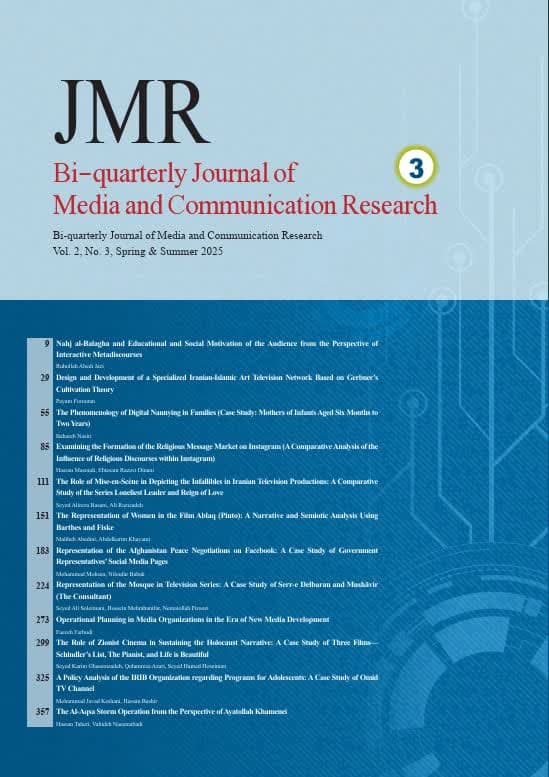
Examining the Formation of the Religious Message Market on Instagram (A Comparative Analysis of the Influence of Religious Discourses within Instagram)

Document Type : Original Article

Authors
1 PhD, Culture and Communications, Islamic Azad University, Central Tehran Branch, Tehran, Iran
2 Assistant Professor, Department of Communication Sciences, Islamic Azad University of Arak, Arak, Iran
10.22034/mcr.2025.480827.1066
Abstract
This study builds upon and extends the authors’ previous research, titled “Discourse Analysis of Religious Messages on Instagram.” The primary objective is to examine the formation of the religious message market on Instagram by comparing the influence of identified religious discourses from the prior study. In that study, five main discourses—modernists, sharia-oriented, civilization-oriented, traditionalists, and moderates—were identified using the PDAM discourse analysis method. The present research quantitatively assesses the influence of each discourse based on this categorization. Using descriptive statistical analysis, the engagement rate was calculated for fifteen selected Instagram accounts over a six-month period. The findings reveal that the Modernist Islamic discourse had the highest influence, accounting for 70.6%, while the Sharia-Oriented discourse had the lowest, at 7%. The results indicate the gradual formation of a competitive market for religious messaging on Instagram, where discourses that align more effectively with audience needs have achieved greater success. By supplementing the qualitative findings of the previous study with quantitative data, this research demonstrates that while social media poses challenges to traditional religious authority, it also facilitates the emergence of new interpretations of religion.
.
Keywords

مسعودی، حسن؛ ابتسام رضوی؛ و سیدوحید عقیلی. (1403 هـ.ش). «تحلیل گفتمان پیام دینی در شبکه اجتماعی اینستاگرام» [رساله دکتری منتشر نشده]. دانشکده علوم اجتماعی و ارتباطات، دانشگاه آزاد اسلامی واحد تهران مرکز.
Clarke, Peter B. (2006). Encyclopedia of new religious movements. London: Routledge.
Digital Marketing Institute. (2022). Engagement Rate: Definition, Metrics and Benchmarks. Retrieved [Insert access date here] from https://digitalmarketinginstitute.com/en-ie/blog/engagement-rate-definition-metrics-and-benchmarks
Hollebeek, Linda D., Glynn, Mark S., & Brodie, Roderick J. (2014). Consumer brand engagement in social media: Conceptualization, scale development and validation. Journal of Interactive Marketing, 28(2), 149-165.
Inoue, Nobutaka (Ed.). (1997). Globalization and indigenous culture. Tokyo: Institute for Japanese Culture and Classics, Kokugakuin University.
Lechner, Frank J. (2004). The globalization reader. Oxford: Blackwell.
Muller, Laura, & Christandl, Fabian (2019). Content is king–But engagement is queen: Developing a metric for social media engagement and its application to professional soccer clubs.
Rival IQ. (2021). 2021 Social Media Industry Benchmark Report. Retrieved from [URL]
Scott, David Meerman (2022). The new rules of marketing and PR (7th ed.). Hoboken, NJ: John Wiley & Sons.
Sehl, K. (2022). How to Calculate Your Engagement Rate on Social Media. Hootsuite Blog. Retrieved from [URL]
Smith, Alyssa (2022, June 9). Instagram engagement rates in 2022: Latest data and trends for marketers. Sprout Social. https://sproutsocial.com/insights/instagram-stats/
Stark, Rodney, & Finke, Roger (1998). Religious choice and competition. American Sociological Review, 63(5), 761-766.
Zinser, Hartmut (2007). The end of secularization. Paper presented at the REVACERN conference, Szeged, Hungary.